Choosing between OEM and ODM is not simply a question of customization. For period underwear brands, the better model depends on how much control you need over product development, how quickly you want to launch, and how much technical work your team can manage.
For functional underwear, this decision matters more than it may seem.
A period underwear product is not just a basic garment with a logo. Fit, gusset coverage, absorbent layers, leakproof construction, fabric selection, testing, packaging, and size grading all affect the final product.
So before asking a manufacturer for a quotation, brands should first decide:
Do we need to build our own product, or do we need to launch a proven product faster?
OEM vs ODM: What Is the Difference?
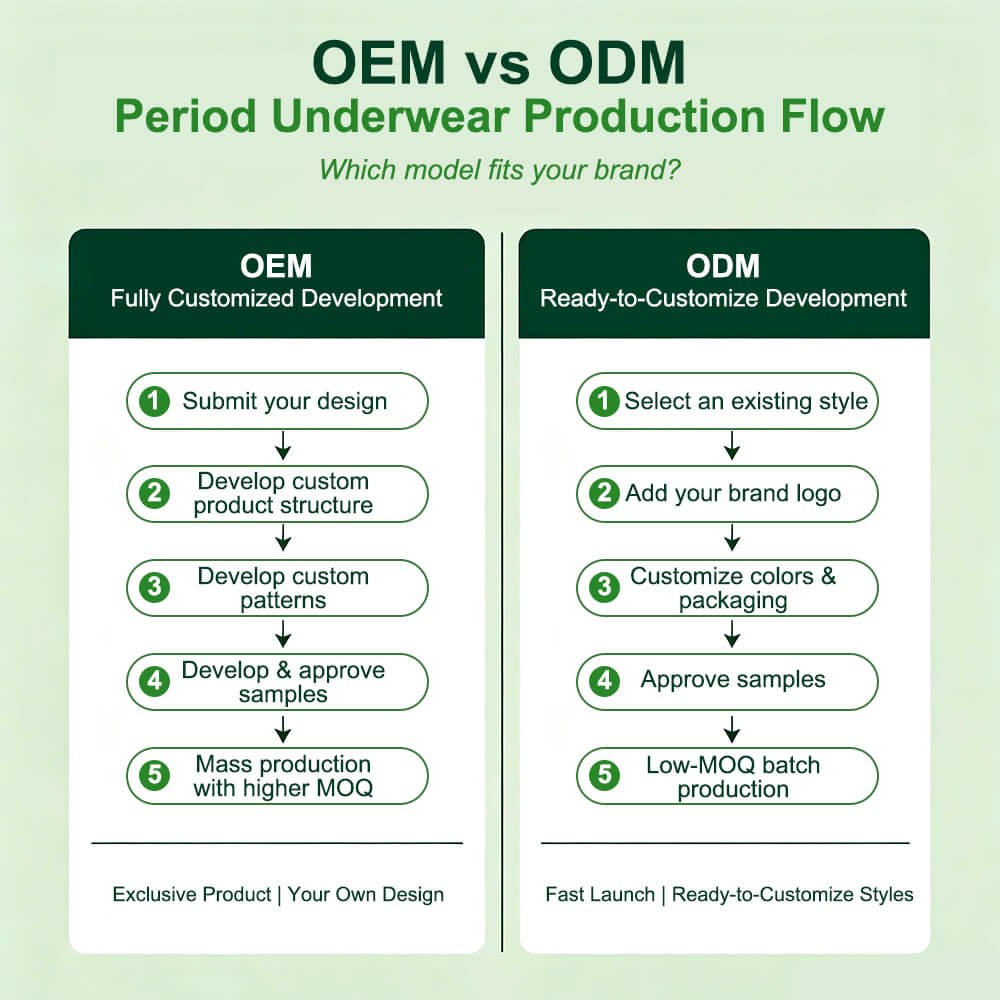
The terminology can vary between manufacturers, but the practical difference is usually the level of product development control.
| OEM | ODM | |
|---|---|---|
| Product concept | Brand-defined | Manufacturer-supported |
| Design control | High | Medium |
| Pattern | Custom | Existing or modified |
| Absorbent structure | Custom-developed | Existing / adapted |
| Fabric | Brand-selected or developed | Manufacturer-selected options |
| Development workload | Higher | Lower |
| Speed to market | Usually slower | Usually faster |
| Product differentiation | High | Medium |
| Best for | Established or differentiated brands | Startups and fast launches |
In other words:
OEM gives you more control. ODM gives you a faster starting point.
Lynmiss currently supports both models, including custom development from a brand’s design or tech pack as well as selection and customization of existing styles, fabrics, functions, logos, and packaging. Lynmiss Factory
1. When Should a Brand Choose OEM?
OEM is usually the better choice when your product itself is part of your competitive advantage.
For example, your brand may already know that you need:
- A specific silhouette
- A proprietary gusset structure
- Extended front or rear coverage
- A specific absorbency target
- Custom fabric composition
- A unique size range
- Special leakproof construction
- Specific testing requirements
In this situation, starting from a standard manufacturer design can create unnecessary compromises.
Instead, the manufacturer develops the product around your specifications.
OEM is a better fit when:
You already have a clear product concept.
You may have a tech pack, sketch, reference sample, pattern, material specification, or detailed product brief.
You want stronger product differentiation.
If your period underwear looks and performs differently from competing products, custom development gives you more room to create that difference.
You plan to build a long-term product line.
For a hero SKU that will remain in your collection for several years, investing more time during development can make sense.
Your product has technical requirements.
Period underwear can require coordination between fit, absorbency, gusset construction, waterproof layers, and testing. These elements should be developed together rather than treated as separate decisions.
A structured OEM brief can help define those requirements before sampling begins. Lynmiss Factory
2. When Is ODM the Better Choice?
ODM is often more practical for brands that want to test the market before investing heavily in product development.
Instead of starting from a blank page, the brand can select an existing style and customize the elements that matter most.
These may include:
- Brand logo
- Label
- Packaging
- Color
- Fabric option
- Absorbency level
- Selected functional features
- Size range
This reduces the amount of product engineering required at the beginning.
ODM is a better fit when:
You are launching your first period underwear collection.
You may understand your target customer but not yet know which product structure will perform best.
Speed is important.
Using an existing and proven product base can reduce development complexity.
You want to test demand first.
Instead of investing heavily in a completely new structure, you can launch a smaller product program and gather customer feedback.
Your differentiation is mainly branding.
For some brands, the competitive advantage comes from brand positioning, packaging, marketing, community, or distribution rather than a proprietary garment structure.
3. Don’t Choose OEM or ODM Based Only on MOQ
MOQ is important, but it should not be the first question.
A more useful question is:
How much product development risk are we willing to take?
A lower-complexity ODM project may allow a brand to test a product category with less development work.
A fully customized OEM project may require more decisions before production, but it gives the brand greater control over the final product.
Lynmiss currently presents both ready-to-order and custom-made pathways, allowing brands to choose between using established styles and developing more customized products. Lynmiss Factory
The right choice therefore depends on the total development cost and commercial objective, not simply the initial unit price.
4. Period Underwear Makes This Decision More Important
For ordinary underwear, changing a fabric or pattern may mainly affect appearance and comfort.
For period underwear, one change can affect several functions at the same time.
For example:
Changing the gusset length can affect coverage.
Changing the absorbent layer can affect capacity, thickness, and drying time.
Changing the fabric can affect stretch, fit, moisture management, and hand feel.
Changing the pattern can affect how the absorbent zone sits against the body.
Changing the size grading can affect leakage protection for different body shapes.
That is why brands should not treat period underwear as ordinary private-label lingerie.
The product should be evaluated as a functional apparel system.
Fit is particularly important because a product can have adequate absorbent capacity but still perform poorly if the gusset, leg opening, or waistband does not stay correctly positioned during movement. Lynmiss Factory
5. A Simple Decision Framework for Brands
If you are unsure which model to choose, start with these five questions.
Choose OEM if you answer “Yes” to most of these:
- Do we already have a detailed product concept?
- Do we need a unique pattern or silhouette?
- Do we need a custom absorbent structure?
- Is product performance part of our brand differentiation?
- Are we building a long-term hero product?
Choose ODM if you answer “Yes” to most of these:
- Are we new to the category?
- Do we want to launch quickly?
- Do we want to test customer demand first?
- Are existing styles close to what we need?
- Is branding more important than proprietary product engineering?
This makes the decision much easier:
Need maximum product control? Start with OEM.
Need a faster market entry? Start with ODM.
6. A Hybrid Approach Can Be Even Better
OEM and ODM do not always have to be two completely separate paths.
For some brands, a hybrid development strategy can reduce risk.
For example:
Stage 1 — ODM
Start with an existing period underwear structure.
Customize:
- Logo
- Packaging
- Color
- Size range
- Selected absorbency options
Launch a small market test.
Stage 2 — Analyze Feedback
Look at:
- Fit complaints
- Leakage complaints
- Preferred absorbency
- Customer size distribution
- Return reasons
- Product reviews
Stage 3 — OEM
Once the brand understands what customers actually want, develop a proprietary version around those findings.
This can turn a market-tested ODM product into a differentiated OEM product.
It is often a more practical path for growing brands than trying to develop a completely new product before they know what the market wants.
7. What Should You Prepare Before Contacting a Manufacturer?
Whether you choose OEM or ODM, the manufacturer still needs a clear product direction.
At minimum, prepare:
- Target customer
- Intended use scenario
- Product style
- Absorbency target
- Size range
- Fabric preference
- Leakproof requirements
- Testing expectations
- Branding requirements
- Packaging requirements
For brands starting with OEM, a structured product brief can reduce unnecessary sample revisions by defining these decisions before development begins. Lynmiss Factory
For ODM projects, the same information helps the manufacturer recommend a suitable existing style rather than simply sending a generic product catalog.
OEM or ODM: Which One Is Right for Your Brand?
There is no universal winner.
OEM is better when product differentiation, technical control, and long-term product ownership are priorities.
ODM is better when speed, lower development complexity, and market testing are priorities.
For period underwear, the most important point is to choose the manufacturing model before the development process becomes complicated.
A good manufacturer should be able to support both approaches and help you move from an existing product to deeper customization as your brand grows.
At Lynmiss Factory, brands can start from an existing product or bring their own concept, tech pack, or reference sample for development. The manufacturing process can then move through material selection, sampling, fit adjustment, functional testing, branding, and production according to the project requirements. Lynmiss Factory
The right question is not “OEM or ODM—which is better?”
It is:
How much of the product do you need to own, and how quickly do you need to bring it to market?