
Introduction: The Risk of Scaling Your Functional Brand
For global apparel brands, Amazon sellers, and institutional distributors, transitioning from a successful prototype to container-load production is the most volatile stage of the supply chain. A generic garment facility might handle a 50-piece sample beautifully, but when orders scale to 100,000+ units, technical inconsistencies often multiply, resulting in catastrophic batch failures.
In the high-stakes world of functional intimates, a 1mm manufacturing error equals a 100% product failure rate. For your private label, a defective batch leads to soaring return rates, plummeting e-commerce ratings, and long-term brand erosion.
As an engineering-first period underwear manufacturer, the technical team at Lynmiss Factory has deconstructed the three most critical defects common in mass-market functional production, and we deploy industrial-grade SOPs to eliminate them at the source.
Defect 1: Functional Layer Delamination and Adhesive Breakdown
The Problem: Consumers frequently report that the absorbent gusset liner starts peeling away from the main fabric after a few wash cycles. Once the integrity of the protective liner is compromised, the garment is rendered useless.
Why it happens: Low-tier manufacturers typically rely on manual heat-press setups or light-adhesive sprays. These bonds lack the mechanical strength to survive the thermal and physical agitation of household washing machines and detergents.
Lynmiss Factory’s Automated Solution: We utilize huge, multi-roller heat press machines to ensure a permanent structural bond.
- Precise Heat & Pressure: Our machines apply uniform, high-intensity pressure and precise, PLC-controlled temperature curves (±1°C). This creates a molecular-level fusion between the technical fabrics and the waterproof barrier.
- Wash Durability: Our lamination protocol is engineered to withstand 50+ rigorous industrial wash cycles without a single millimeter of separation, ensuring your product’s structural integrity remains intact for the entire lifecycle.
Defect 2: Seam Leakage (The “Needle-Hole” Crisis)
The Problem: Even with a high-performance absorbent core, fluid frequently leaks through the side seams. This is the primary driver of customer “leakage complaints” and negative product reviews.
Why it happens: Standard sewing needles puncture the waterproof TPU membrane thousands of times during assembly. These invisible needle holes act as tiny channels, allowing fluid to wick out to the garment edges under body pressure.
Lynmiss Factory’s Automated Solution: We deploy a dual-layer defense system to seal every seam:
- Patented Side Shielding: Our design integrates a physical barrier (CN 214759172 U) that prevents fluid from reaching the seam area, detailed in our technical breakdown: 4-Layer Leakproof Technology Breakdown.
- Double-Layer PUL Encapsulation: We utilize advanced (encapsulation) techniques. Instead of sewing directly through the membrane, our technical operators fold and seal the waterproof layer within the seam construction. This means the sewing needle never actually penetrates the core fluid barrier.
See our factory-floor testing video below to witness how our double layer reversed wrappinghandles heavy fluid pressure with zero bypass:
Defect 3: Inconsistent Sizing & Core Displacement
The Problem: Brands often receive shipments where the absorbent gusset is misaligned or the garment fit varies wildly between units, leading to complaints about the product being “bulky” or “uncomfortable.”
Why it happens: Inconsistent tension during manual sewing. When fabric layers are guided through the machine by hand, the absorbent core tends to stretch or bunch, causing the garment to lose its intended ergonomic shape.
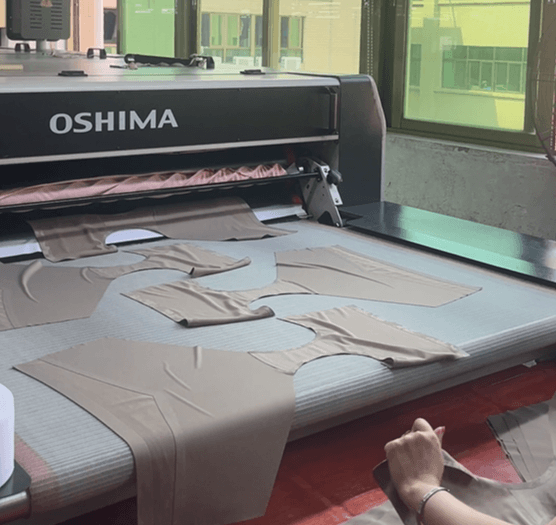
Lynmiss Factory’s Automated Solution: We utilize Intelligent Tension Feeders and CNC Automated Cutting to achieve外科手术级 (surgical) consistency.
- Automated Tension Control: Our sewing stations are equipped with electronic tension feeders that automatically calculate and maintain the correct feed rate for each fabric layer. This keeps the gusset perfectly flat and smooth, regardless of size.
- CNC Precision: All gusset panels are cut using automated CNC systems with 0.1mm tolerance. Whether you are ordering a 500-piece capsule or a 1.5-million-unit bulk order, as outlined in How Lynmiss Factory Scales Production, every piece is identical to the prototype.
Factory Insight: The “Zero-Defect” Standard
Consistency is the result of a rigorous, audit-ready quality ecosystem:
- Material Pre-Scan: We validate every fabric batch for absorbency and safety (OEKO-TEX® & GRS standards) before it reaches our lines.
- In-Line Verification: Our bonding systems pause automatically if pressure or temperature deviates by even 1%.
- 100% Metal Detection: Before packaging, every garment passes through our conveyor-belt industrial metal detectors, ensuring 100% safety from needle fragments. (Full SOP details here: Zero-Metal Contamination Protocol.
Conclusion: Secure Your Brand’s Long-Term Reputation
A successful functional apparel brand is built on reliability, not just the lowest cost. By partnering with a vertical factory that treats every stitch as an engineering challenge, you secure your brand’s future and drastically lower your return costs. Whether you are looking for an expert incontinence underwear manufacturer or a high-capacity period wear partner, Lynmiss Factory provides the technical infrastructure you need.
Scale Your Brand with Lynmiss Factory
- Need to review our quality standards? Download Our Certifications
- Want to discuss a custom design? View Our Custom OEM/ODM Services
- Ready for a sample? Contact Our Engineering Team for a Quote
Our team is standing by to help you eliminate defects and grow your functional apparel portfolio.