
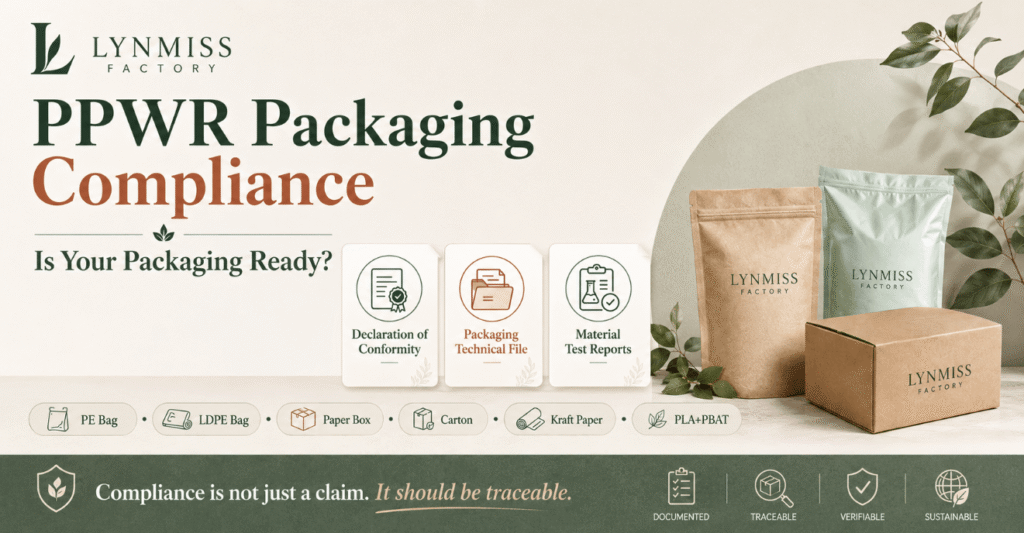
Your period underwear may have passed fabric testing, PFAS screening, absorbency testing, and quality inspection.
But what about the PE bag, printed box, ink, adhesive, lamination film, kraft paper, and shipping carton around it?
For brands selling into Europe, packaging can no longer be treated only as a branding decision.
The EU Packaging and Packaging Waste Regulation, Regulation (EU) 2025/40 — commonly known as PPWR — generally applies from 12 August 2026. It covers packaging regardless of material or origin and introduces requirements across the packaging life cycle, including manufacturing, composition, waste prevention, recyclability, documentation, and traceability.
For period underwear and reusable incontinence brands, this creates a new sourcing question:
Can your supplier provide not only customized packaging, but also the documentation behind it?
PPWR Is More Than an “Eco-Friendly Packaging” Claim
Words such as recyclable, sustainable, biodegradable, or eco-friendly are useful for marketing, but they are not a substitute for packaging documentation.
A sourcing team should be able to answer:
- What material is this packaging made from?
- Which supplier supplied the material?
- Can the packaging be uniquely identified?
- What supporting reports are available?
- Is there technical documentation for the approved specification?
- If the material changes, can the records be updated?
Under PPWR, manufacturers are required to carry out the applicable conformity assessment and draw up technical documentation. When compliance with the applicable requirements has been demonstrated, the manufacturer draws up an EU Declaration of Conformity. PPWR also requires identification such as a type, batch, serial number, or another element allowing the packaging to be traced.
This is why packaging compliance increasingly depends on documentation as well as the physical package.
An EU Declaration of Conformity Is Not Just Another Certificate
An EU Declaration of Conformity is different from a third-party certification badge.
Under PPWR, drawing up the declaration means the manufacturer assumes responsibility for the packaging’s compliance with the applicable requirements of the Regulation. The declaration follows the structure established by the Regulation and must be kept updated.
For buyers, this makes the document useful because it connects a specific packaging specification with its manufacturer, identification, material information, relevant requirements, and supporting technical documentation.
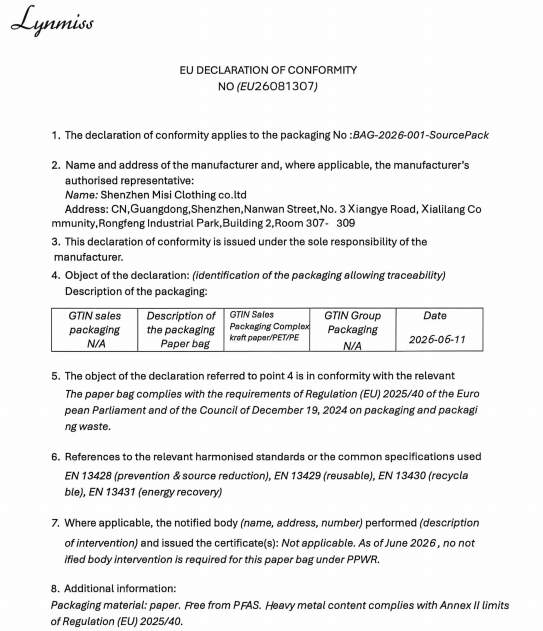
Suggested image caption:
Example of an EU Declaration of Conformity maintained for a Lynmiss Factory packaging specification. Packaging records can be connected with material identification and supporting technical information to improve traceability.
This is the best place for your DoC image because the reader has just learned what the document means. Instead of appearing as a random “certificate,” it becomes evidence supporting the compliance process.
Why Material-by-Material Traceability Matters
A private-label underwear package is rarely made from only one material.
A typical order may involve:
PE bag → retail box → lamination film → printing ink → adhesive → shipping carton
If all of these are simply recorded as “custom packaging,” tracing a problem later becomes difficult.
At Lynmiss Factory, packaging information is being organized material by material. Different packaging components can be assigned individual identification numbers and connected with relevant material information and supporting reports.
Current packaging records can cover materials such as:
- PE packaging bags
- LDPE or self-sealing bags
- Printed retail boxes
- Corrugated cartons
- Lamination films
- Printing inks
- PVA adhesives
- PLA + PBAT packaging
- Kraft paper
For sourcing teams, this creates a clearer chain:
Packaging ID → Material Specification → Supporting Test Report → Technical Documentation → Declaration
The same traceability principle is already important in apparel compliance. Our guide to GCC and CPSC eFiling for period underwear explains why product identification, testing information, and supporting documentation need to remain connected when brands enter regulated markets.
Chemical Testing Should Support the Actual Packaging Specification
Packaging documentation should also reflect the materials actually being used.
PPWR establishes requirements concerning substances of concern in packaging and places restrictions on certain heavy metals. However, brands should avoid assuming that every chemical requirement applies identically to every packaging category. For example, PPWR’s specific PFAS concentration restrictions are directed at food-contact packaging, rather than creating a general PFAS threshold for every apparel package.
That does not mean apparel brands cannot request PFAS testing.
A brand may still include PFAS screening, restricted-substance testing, or other chemical requirements as part of its own supplier policy or sustainability program.
The important principle is that claims should match the actual test scope.
This is also true for functional apparel. Brands using PFAS-free positioning should understand what has actually been tested, as explained in our article What Does PFAS-Free Really Mean in Period Underwear?.
Packaging Changes Should Trigger Documentation Review
One small packaging change can affect more than appearance.
Changing from one PE bag supplier to another, replacing an adhesive, changing a coating, modifying a laminated structure, or switching paper grades may mean the associated documentation also needs to be reviewed.
PPWR requires manufacturers to take changes in packaging design, characteristics, standards, and technical specifications into account when maintaining conformity in series production. Where a change could affect conformity, reassessment may be necessary.
For buyers, this makes version control increasingly important.
The packaging approved during sampling should remain connected to the packaging actually used during bulk production.
This approach is similar to garment production, where approved fabrics and functional layers must remain consistent from sample to bulk. Our period underwear quality control guide explains why material inspection and traceability should begin before production rather than at final inspection.
Sustainability Should Start Before Packaging Is Produced
PPWR is not only about documentation.
Its broader objective is to reduce unnecessary packaging, reduce dependence on primary raw materials, increase reuse and recycling, and move packaging toward a more circular system. The EU aims for packaging placed on its market to become recyclable in an economically viable way by 2030.
For private-label period underwear brands, packaging development can therefore consider:
- Removing unnecessary packaging layers
- Reducing oversized retail boxes
- Using simpler material combinations
- Considering recyclable paper-based options
- Evaluating kraft paper or alternative packaging
- Reducing unnecessary plastic where practical
- Reviewing inks, coatings, adhesives, and lamination choices
The goal should not be to make packaging look sustainable.
It should be to make better packaging decisions while maintaining protection, branding, logistics performance, and applicable compliance requirements.
How Lynmiss Factory Is Preparing
At Lynmiss Factory, PPWR preparation is not simply about collecting files in one folder.
We are developing a more structured packaging documentation system in which different materials can be connected with their own identification, material information, test reports, technical documentation, and supporting declarations where applicable.
This supports packaging used across period underwear, reusable incontinence underwear, period swimwear, and other private-label functional apparel programs.
For buyers, it also creates a clearer response when a compliance or sourcing team asks:
“What exactly is this packaging made from, and what documentation supports it?”
Final Takeaway
Reusable period underwear and reusable incontinence products already encourage consumers to rethink dependence on disposable products.
Packaging should move in the same direction.
As PPWR becomes part of everyday European sourcing decisions, responsible packaging is no longer just about a recyclable symbol or an environmental claim.
It is increasingly about:
Materials. Identification. Testing. Traceability. Documentation. Better design.
At Lynmiss Factory, we believe a responsible manufacturing partner should help brands think beyond the garment itself — from functional materials and product testing to the packaging that finally reaches the customer.
Compliance should not stop at the product.
Explore Lynmiss Factory OEM/ODM manufacturing and packaging capabilities at www.misiundies.com.
This article provides general B2B sourcing information and does not constitute legal advice. Product- and market-specific PPWR obligations should be confirmed with qualified compliance professionals.