
A period underwear sample can pass absorbency testing and still fail in real wear.
The problem is often not the absorbent core. It is the fit.
If the gusset sits too far forward, the leg opening loosens during movement, or the waistband rolls when the wearer sits, liquid can reach an unprotected area even when the absorbent materials perform correctly.
For brands, fit should be evaluated as part of functional performance—not as a separate aesthetic issue. During sampling, the pattern, gusset, elastic tension, rise, and size grading all need to work with the intended absorbency level and use scenario.
Here are seven fit problems brands should correct before mass production.
1. The Gusset Sits in the Wrong Position
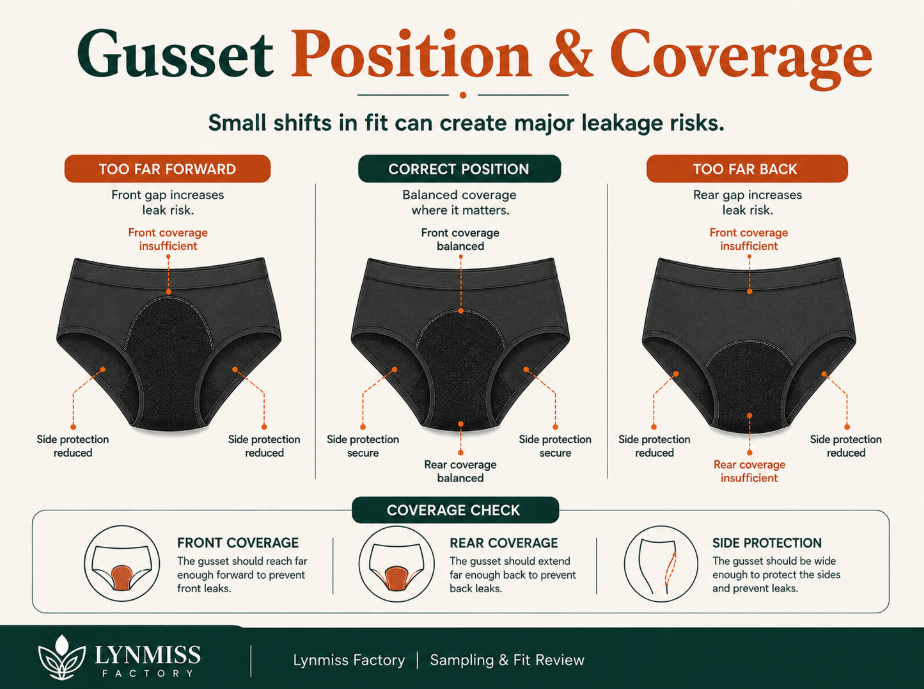
The absorbent zone may have enough capacity, but it cannot protect the wearer if it is not positioned where fluid actually reaches the garment.
A gusset that sits too far forward may leave insufficient rear protection. If it sits too far back, front coverage may become inadequate. The problem can become more obvious during sitting, walking, or sleeping.
Brands should check gusset position on the body, not only on a flat sample. Front and rear extension should also match the intended use case. Moderate daytime products, heavy-flow briefs, and overnight styles may require different coverage.
This is one reason leakage complaints should never be analyzed from absorbency data alone. Our guide to reducing period underwear leakage complaints before production explains how capacity, coverage, fit, and leg openings work together.
2. The Gusset Is Too Narrow
A narrow gusset can feel discreet, but it may create a protection zone that is smaller than the user needs.
During movement, liquid can spread toward the side edges before the absorbent core reaches maximum capacity. If the waterproof barrier or absorbent area does not extend far enough, side leakage can occur.
Brands should review the narrowest part of the gusset, the width of the waterproof layer, and how the garment sits between the legs in different sizes.
A gusset should not simply be scaled down in the same proportion as the garment.
For some products, especially heavy-flow and overnight styles, slightly wider or longer protection may provide better real-wear performance than simply increasing absorbent-core thickness.
3. Leg Openings Are Too Loose or Too Tight
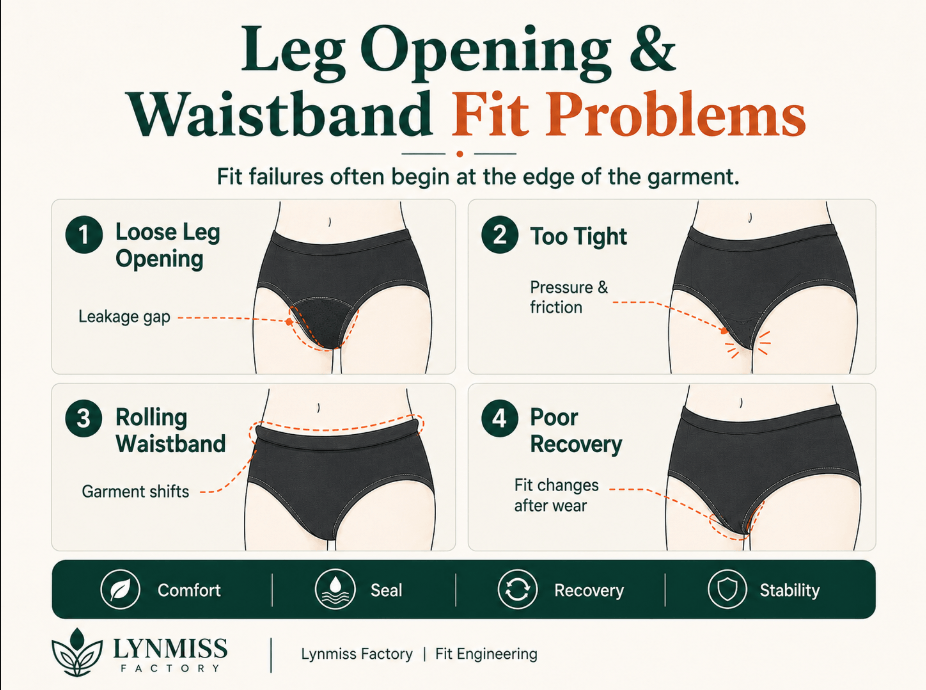
Leg-opening tension directly affects comfort and leakage control.
If the opening is too loose, gaps can appear around the inner thigh and create a path for leakage. If it is too tight, the wearer may experience digging, friction, visible marks, or discomfort during long wear.
Brands should test leg openings while the wearer is standing, sitting, walking, and stretching.
The construction method also matters. Bonded edges, sewn elastics, and hybrid structures may behave differently after repeated movement and washing. If different constructions are being compared during sampling, our guide to bonded vs traditional seam construction explains how seam choices can affect edge stability, comfort, and product structure.
4. The Waistband Rolls or Loses Recovery
A waistband that looks correct on a mannequin may roll once the wearer sits, bends, or moves.
This can happen when the waistband is too wide for the body shape, elastic recovery is insufficient, or rise and waist tension are not balanced.
Rolling is more than a visual problem. If the garment shifts downward, the gusset position can change too.
Sampling should include repeated sitting and movement, not just a standing fit check. After stretching, the waistband should return close to its original shape without becoming loose or overly restrictive.
Post-wash recovery should also be reviewed because elastic behavior can change after repeated laundering.
5. The Rise Does Not Match the Product Style
Front and back rise influence where the garment sits and how stable the protection zone feels.
A low rise may work for a lightweight bikini, but it may not provide enough stability for a high-capacity overnight product. A very high rise can create excess fabric or folding if the pattern does not match the target body shape.
Brands should define the silhouette and use case before finalizing the rise.
A moderate-flow school-day brief may prioritize discreetness and movement, while an overnight style may need a more stable waistband and greater rear coverage.
This is why the garment style, absorbency target, and fit should be developed together instead of being decided independently.
6. Size Grading Changes the Functional Fit
A common sampling mistake is assuming that a good medium-size sample will automatically perform well across the full range.
As patterns are graded up or down, the relationship between the gusset, leg openings, rise, and body can change.
A gusset that is correctly positioned in size M may sit too far forward in XS or become too narrow relative to the body in 3XL. Elastic tension may also feel different across sizes.
Brands should review key size breaks during sampling instead of approving one size only.
This is especially important for teen, plus-size, and incontinence ranges, where body proportions and functional requirements may differ from the core adult size set.
7. The Sample Is Tested Standing Still
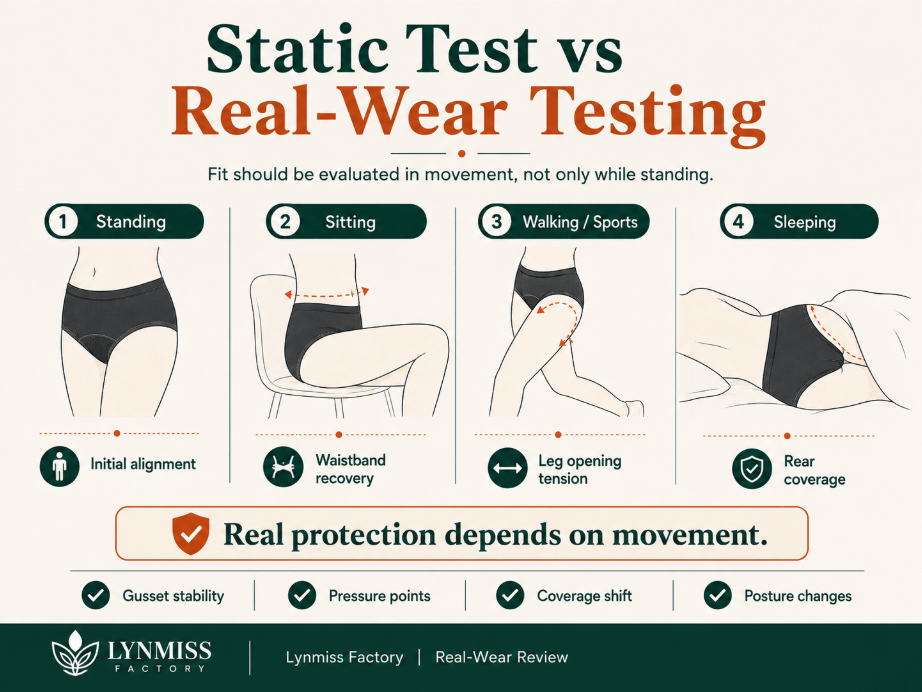
A static fit test cannot show what happens during real wear.
Period underwear is used while sitting at school or work, walking, exercising, driving, and sleeping. Each position changes pressure, garment tension, and the location of the absorbent zone.
A stronger sampling process should include movement checks, seated fit, overnight-position review where relevant, and post-wash fit evaluation.
These checks should be combined with leakproof testing before mass production so the development team can identify whether a failure comes from absorbency, coverage, construction, or fit.
A sample that performs well while lying flat but leaks during movement should not automatically receive a thicker absorbent core. The actual failure point needs to be identified first.
How Brands Should Evaluate Fit During Sampling
Before approving a period underwear sample, brands should confirm:
- Gusset position on the body
- Front and rear protection coverage
- Narrowest gusset width
- Leg-opening tension
- Waistband stability
- Front and back rise
- Stretch recovery after movement
- Fit after washing
- Performance across key sizes
- Stability during the intended use scenario
The goal is not to create the tightest fit possible.
The goal is to keep the functional protection zone in the correct place without creating pressure, friction, rolling, or unnecessary bulk.
How Lynmiss Factory Supports Fit Development
At Lynmiss Factory, period underwear development can include pattern adjustment, gusset positioning, size grading, absorbency selection, fabric comparison, sewn or bonded construction, and pre-production performance review.
For OEM and ODM projects, our custom period underwear manufacturing process can support fit, functional structure, material, absorbency, color, logo, and packaging development according to the target user and market.
Instead of evaluating only how a sample looks on a table, brands can use the sampling stage to identify how the complete garment behaves during actual wear.
Final Takeaway
A period underwear product can have the right fabric, absorbency, and waterproof layer—and still perform poorly if the fit is wrong.
Gusset position, leg-opening tension, waistband recovery, rise, and size grading all influence whether the protection stays where it is needed during real wear.
For brands, fit should be treated as part of leakproof engineering.
Fixing these issues during sampling is far easier than correcting leakage complaints, returns, and poor reviews after mass production.