
One of the easiest ways to simplify a reusable incontinence underwear collection is to use one absorbent core and adjust only its thickness.
It is also one of the easiest ways to create the wrong product.
Light bladder leakage during coughing or exercise, moderate daily leakage, and longer overnight protection do not place the same demands on an absorbent system.
The difference is not only how much liquid the product needs to hold.
Brands also need to define how quickly the liquid arrives, how it should spread, how much pressure the core experiences, where the protection is positioned, and how dry the surface should remain after absorption.
For OEM development, the correct question is therefore not:
“How much absorbency do we need?”
It is:
“What type of leakage is this product being engineered to manage?”
Start With the Leakage Scenario, Not Maximum Capacity
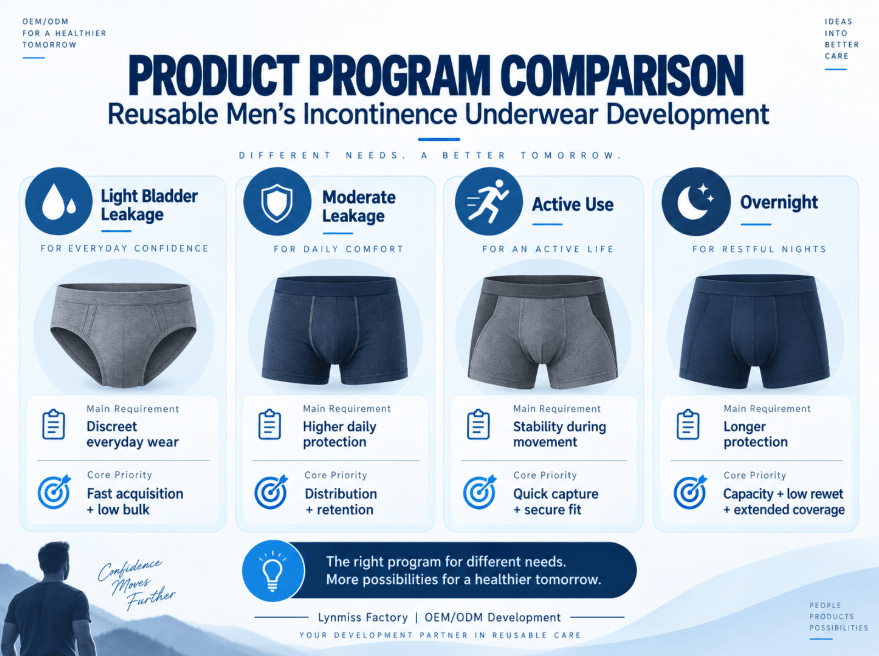
Before choosing an absorbent material, brands should define the intended use case.
A reusable product for occasional light bladder leakage may need fast liquid capture with minimal bulk.
A moderate-protection product may require stronger distribution and retention.
An overnight product may need higher capacity, better pressure resistance, extended rear coverage, and lower rewet over a longer wearing period.
A single core cannot automatically meet all of these requirements simply by adding or removing absorbent material.
| Product Program | Main Requirement | Core Development Priority |
|---|---|---|
| Light Bladder Leakage | Discreet everyday wear | Fast acquisition + low bulk |
| Moderate Leakage | Higher daily protection | Distribution + retention |
| Overnight | Longer protection | Capacity + low rewet + extended coverage |
| Active Use | Stability during movement | Fast capture + secure fit |
| Postpartum / Mature User | Comfort + protection | Softness + coverage + ease of wear |
These are development directions rather than universal performance standards. Final specifications should be confirmed through product-specific testing.
1. Acquisition Speed and Capacity Are Different
Brands often begin an OEM brief with a target such as:
“We need 60 ml.”
But capacity alone does not explain how the product should behave.
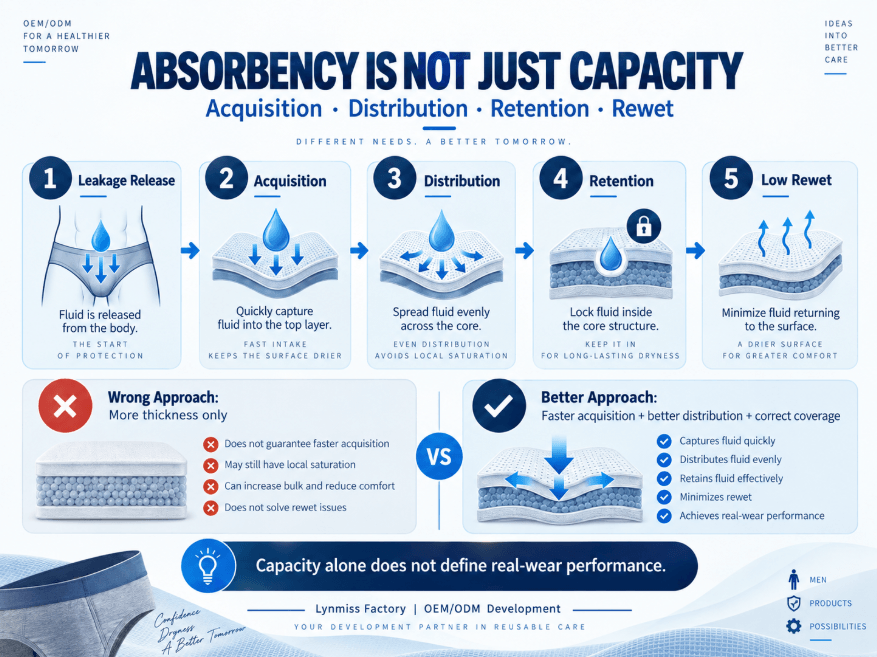
Urine may be released quickly. If the skin-contact layer and acquisition layer cannot move liquid into the core fast enough, fluid may spread toward the edges before the total capacity is reached.
The development team should therefore separate:
Acquisition speed — How quickly does liquid enter the core?
Distribution — Does the liquid spread through the usable absorbent area?
Retention — Can the core hold the liquid once captured?
Total capacity — How much can the complete garment manage under the agreed test method?
This is one of the main reasons menstrual and urinary fluid-management systems should not simply be treated as the same product with different capacity labels. Our guide to period underwear vs incontinence underwear engineering explains why the fluid behavior and core priorities differ.
2. Higher Capacity Should Not Automatically Mean More Thickness
The simplest way to increase absorbency is to add more absorbent material.
But that can also increase:
- Gusset thickness
- Drying time
- Heat buildup
- Stiffness
- Visible bulk
- Material cost
For a daily light-leakage product, this may create more protection than the user actually needs while reducing wearability.
A better product-development approach may combine:
Fast acquisition + efficient distribution + appropriate retention + correct coverage
instead of relying only on additional core thickness.
The objective should be the right core for the target leakage scenario, not the maximum possible capacity in every SKU.
3. Rewet Should Be a Separate Approval Criterion
A product can absorb liquid successfully and still feel wet during use.
This happens when moisture returns toward the skin-contact surface under pressure.
For reusable incontinence underwear, pressure can occur while the wearer is:
- Sitting
- Driving
- Sleeping
- Exercising
- Wearing tight outer clothing
Brands should therefore include rewet or surface-dryness expectations in the sample approval process.
A development sample may show:
Capacity: PASS
Leakproof barrier: PASS
Rewet: FAIL
In that situation, simply increasing total capacity may not solve the problem.
The core structure, acquisition layer, distribution method, or retention material may need to be adjusted.
4. Where the Core Is Placed Matters as Much as Its Capacity
Absorbency must be positioned correctly.
A high-capacity core that is too narrow, too short, or poorly positioned may still allow leakage.
Brands should define:
- Central absorbent-zone width
- Front extension
- Rear extension
- Waterproof-zone dimensions
- Leg-opening relationship
- Gusset position across sizes
Different use scenarios may require different protection zones.
For example, an active product may prioritize a stable central zone and secure leg openings, while an overnight product may need longer rear protection.
Fit and core design therefore need to be developed together. Our article on common fit problems in period underwear sampling explains how gusset position, leg-opening tension, rise, and size grading can change functional protection even when the absorbent material itself performs correctly.
5. Fit Should Not Be Used to Compensate for Weak Core Design
Another common shortcut is making the underwear tighter to control leakage.
That can create:
- Leg-opening pressure
- Skin friction
- Waistband discomfort
- Rolling
- Poor size consistency
The purpose of fit is to keep the functional zone stable against the body—not to squeeze the garment tightly enough to compensate for slow liquid acquisition or insufficient coverage.
For OEM sampling, fit should be reviewed during standing, sitting, walking, and other intended-use movements.
A product for active light bladder leakage should not necessarily use the same rise, gusset position, or leg-opening tension as an overnight product.
6. Odor Management Should Be Defined During Material Development
Odor control is another reason one core should not be used across every product without modification.
Higher-capacity or longer-wear products may require a different moisture-management strategy from light everyday styles.
Brands should decide early whether they require:
- Silver-ion yarn or material
- Other odor-management technology
- Specific placement within the functional layers
- Wash-durability expectations
- Supporting antibacterial or odor-control testing
Odor technology should not be added only after the final sample is completed.
Our guide to how silver ion technology controls odor explains how material placement, wash durability, and claim support should be considered during development.
What Should Brands Put in an Incontinence Underwear OEM Brief?
A stronger brief separates performance requirements instead of asking only for “high absorbency.”
| Brief Item | Example |
|---|---|
| Target User | Women 45+ |
| Leakage Level | Light to moderate |
| Release Pattern | Sudden, small-volume leakage |
| Use Scenario | Everyday wear |
| Target Capacity | Product-specific target |
| Acquisition | Fast |
| Rewet Requirement | Low |
| Gusset | Wider central protection zone |
| Body Fabric | Breathable nylon/spandex |
| Skin-Contact Layer | Soft moisture-management fabric |
| Odor Control | Required |
| Construction | Sewn / bonded comparison |
| Size Range | S–4XL |
| Wash Testing | Defined before sampling |
This gives the manufacturer a clearer product target than simply specifying a milliliter number.
How Lynmiss Factory Supports Incontinence Product Development
At Lynmiss Factory, reusable incontinence underwear can be developed according to the intended leakage scenario rather than using one universal absorbent structure.
Depending on the program, development can include:
- Different acquisition and absorbent layers
- Customized capacity
- Rewet control
- Extended gusset coverage
- Odor-management materials
- PFAS-free leakproof barriers
- Sewn, bonded, or hybrid construction
- Size grading
- Wash-performance testing
- Private-label branding and packaging
The goal is to match the absorbent system, fit, materials, and construction to the actual product position before mass production begins.
FAQ
Can one absorbent core be used for light and heavy incontinence products?
It may be possible to share some materials, but simply changing thickness is not always sufficient. Acquisition speed, distribution, rewet, coverage, and fit may need separate development.
Is higher absorbency always better for reusable incontinence underwear?
No. Excess capacity can increase bulk, drying time, and cost. Brands should define capacity according to the intended leakage scenario.
What should brands test besides capacity?
Useful performance criteria can include acquisition speed, retention, rewet, edge leakage, fit, wash durability, and size consistency.
When should odor-control materials be selected?
Ideally during material development, before the final sample is approved, so placement, durability, testing, and claims can be evaluated together.
Final Takeaway
Reusable incontinence underwear should not be developed as one universal absorbent core offered in several thicknesses.
Light leakage, moderate daily protection, active wear, and overnight use create different demands on acquisition, distribution, retention, rewet, coverage, fit, and odor management.
For brands, defining those differences before sampling makes it easier to build a clear product line—and reduces the risk of creating multiple SKUs that look different but perform almost the same.
One user scenario → one clear performance target → the right core structure.
Explore Lynmiss Factory OEM/ODM functional underwear development at www.misiundies.com