Most sampling delays start before the first sample is made.
A brand may ask for “heavy-flow period underwear with cotton fabric and custom packaging,” but that description still leaves many technical decisions unanswered.
Heavy flow for daytime or overnight? How much rear coverage? Which cotton fabric? What size range? What does “PFAS-free” refer to? Which tests must the finished garment pass?
When these questions are answered only after the first sample arrives, every new decision can create another revision.
A clear period underwear OEM brief helps both the brand and manufacturer understand the same product before development begins.
What Should a Period Underwear OEM Brief Include?
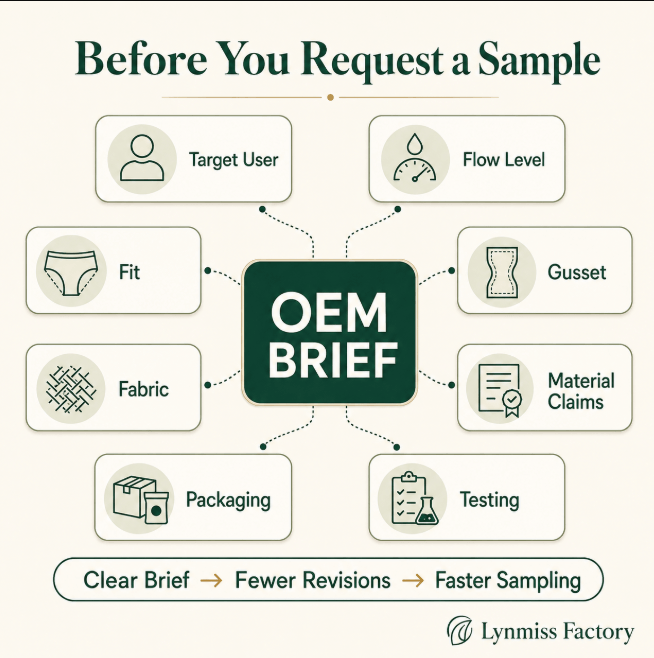
A useful OEM brief should define:
- Target user
- Real use scenario
- Absorbency level
- Gusset coverage
- Fit and size range
- Fabric requirements
- Material and compliance claims
- Branding and packaging
- Testing and sample approval criteria
The goal is not to create a complicated document. It is to remove uncertainty before sampling.
1. Define the Target User First
The first question should be:
Who is this product being designed for?
An adult everyday brief, teen first-period product, postpartum style, active product, and reusable incontinence garment may require different fits and functional structures.
A brand should define the user group before selecting a pattern.
For example:
- Adult everyday users
- Teens or first-period users
- Heavy-flow users
- Postpartum users
- Active or sports users
- Light bladder leakage users
This decision affects rise, leg openings, gusset position, fabric, coverage, and size grading.
For teen collections in particular, simply reducing an adult pattern can create fit and coverage problems. This is one reason brands should review common fit problems in period underwear sampling before approving the final pattern.
2. Define the Real Use Scenario
“Period underwear” is not a complete use case.
A better OEM brief should explain whether the product is intended for:
Regular daytime wear
Heavy-flow days
Overnight protection
School
Sports
Travel
Swimming
Light incontinence
The scenario influences the complete garment.
An overnight style may need extended rear coverage. An active product needs stable leg openings and stretch recovery. Period swimwear must control external water intake as well as menstrual leakage.
Two products with the same absorbency target may therefore require very different construction.
3. Specify Absorbency — But Not Only in Milliliters
Absorbency is important, but writing “30 ml” alone is not enough.
The brief should ideally include:
- Target capacity
- Flow level
- Expected wearing time
- Standalone or backup use
- Daytime or overnight scenario
Brands should also define whether they care about absorption speed, surface dryness, or rewet performance.
A product can hold 30 ml in a controlled test and still leak during actual wear if liquid reaches the gusset edge too quickly.
That is why leakproof testing before mass production should evaluate the complete garment rather than only the absorbent material.
4. Define Gusset Coverage and Fit
Fit should be part of the technical brief.
Brands should specify or discuss:
- Front gusset extension
- Rear gusset extension
- Gusset width
- Preferred rise
- Leg-opening fit
- Waistband style
- Size range
The correct protection zone depends on the body and use scenario.
A high-capacity absorbent core cannot compensate for a gusset that sits too far forward or a loose leg opening that creates a leakage gap.
This is particularly important when developing heavy-flow, overnight, teen, or extended-size products.
5. Be Specific About Fabric
“We want cotton” can still create several rounds of questions.
Which part of the garment should use cotton?
The body fabric? Skin-contact lining? Gusset top layer?
A useful fabric brief can specify:
- Body fabric preference
- Skin-contact layer
- Fiber composition
- GSM or weight range
- Stretch and recovery
- Handfeel
- Breathability
- Quick-dry expectations
- Required certifications
If the brand wants organic cotton, it should also confirm whether certified material or chain-of-custody documentation is required.
Brands considering this direction can review our organic cotton period underwear OEM guide before choosing the final fabric structure.
6. Define Material and Compliance Claims Early
Compliance questions should not appear after the sample has already been approved.
If the final product will be marketed using claims such as:
- PFAS-free
- Organic cotton
- Recycled material
- OEKO-TEX
- GOTS
- GRS
the requirements should be discussed before material sourcing.
Brands should clearly state:
Which material needs the claim?
Which market is the product entering?
What reports or certificates will be required?
A manufacturer may be able to offer several material options, but not every material supports the same documentation.
The earlier these expectations are defined, the lower the risk of changing materials late in development.
7. Decide Branding and Packaging Before the Final Sample
Packaging often looks like the last step, but it can create additional sampling delays.
Brands should define:
- Logo method
- Washing label
- Heat-transfer care label
- Hangtag
- Individual bag
- Paper box
- Kraft packaging
- Barcode requirements
- Packaging sustainability claims
A change from a simple bag to a retail box may affect dimensions, artwork, MOQ, cost, and shipping volume.
If packaging requires special environmental claims, the supporting documentation should also be considered before final approval.
8. Agree on Testing and Approval Criteria
A sample should not be approved simply because it “looks good.”
The brand and manufacturer should agree on what the sample needs to pass.
Depending on the product, this may include:
- Absorption capacity
- Absorption speed
- Rewet
- Side leakage
- Rear leakage
- Wash durability
- Stretch recovery
- Fit
- Size grading
- Seam or bonding stability
- Appearance
This creates a clearer definition of an approved sample.
If the fabric, gusset, pattern, membrane, or construction changes later, the relevant performance checks may need to be repeated.
Period Underwear OEM Brief Example
| Brief Item | Example |
|---|---|
| Target User | Adult women, 18–35 |
| Use Scenario | Heavy-flow daytime |
| Absorbency | Target 30 ml |
| Style | High-waist brief |
| Gusset | Extended rear coverage |
| Fabric | Nylon/spandex body + cotton lining |
| Material Claim | PFAS-free leakproof barrier |
| Size Range | XS–3XL |
| Branding | Heat-transfer logo |
| Packaging | Kraft paper bag |
| Testing | Absorption, rewet, wash and fit |
| Target MOQ | 1,000 pcs/style |
This does not replace a detailed tech pack, but it gives the development team enough direction to begin more efficiently.
How Lynmiss Factory Supports OEM Development
At Lynmiss Factory, period underwear development can begin from a complete tech pack or an initial product concept.
For brands that do not yet have every technical detail finalized, our custom period underwear manufacturing process can support decisions around absorbency, gusset structure, fit, fabrics, sewing or bonding, size grading, testing, branding, and packaging.
The clearer the development brief becomes before sampling, the easier it is to compare samples against a defined product target rather than making decisions one revision at a time.
FAQ
Do I need a full tech pack before requesting a period underwear sample?
Not always. A detailed tech pack is useful, but brands can also begin with a structured OEM brief covering the target user, style, absorbency, fit, fabric, size range, and testing requirements.
Why does period underwear often require more sample revisions than standard underwear?
Period underwear combines fit with functional layers, absorbency, waterproofing, and leakage protection. Changing one element can affect several others.
When should testing requirements be confirmed?
Ideally before sampling begins. This allows the sample to be designed around the intended performance criteria rather than adding testing requirements after the product has already been developed.
What causes the most sampling delays?
Unclear use scenarios, changing absorbency requirements, undefined fit expectations, late material claims, and packaging decisions made after the garment is already approved are common causes.
Final Takeaway
A good OEM brief does more than tell a manufacturer what the product should look like.
It defines who will use it, how it will be used, what it needs to protect against, how it should fit, what claims it must support, and how success will be tested.
For period underwear brands, those decisions can mean the difference between repeated sample revisions and a much clearer path to mass production.
Clear brief → fewer revisions → faster sampling → lower development risk.
Explore Lynmiss Factory OEM/ODM period underwear development at www.misiundies.com.