
For global supply chain managers and QA directors in the technical textile industry, vetting a functional apparel vendor requires looking past marketing jargon. In the high-liability sector of protective underwear, one of the most expensive sourcing errors is partnering with an OEM/ODM vendor that implements a universal absorbent core for both menstrual discharge and urinary incontinence.
Labeling a standard period panty as an adult incontinence garment compromises product safety, elevates consumer return rates, and creates severe product liability risks under strict EU and US retail regulations.
As a vertically integrated period underwear manufacturer with comprehensive in-house R&D, Lynmiss Factory treats these two categories as distinct engineering frameworks. Below is the technical breakdown of how we differentiate core micro-architectures based on fluid dynamics and chemical compositions.
- Rheological & Hydrodynamic Analysis: Menstrual vs. Urinary Fluid Profiles
To engineer an effective textile barrier, product development teams must analyze the fluid profiles under mechanical pressure (such as sitting or moving).
- Menstrual Discharge (Non-Newtonian Fluid): High-viscosity liquid containing organic cellular debris, mucus membranes, and blood clots. It exhibits non-Newtonian behavior, meaning its viscosity changes under stress. The discharge pattern is slow, low-velocity, and highly localized.
- Urinary Incontinence (Newtonian Fluid): Low-viscosity, water-like Newtonian fluid discharged at an instantaneous, high-velocity surge. The volume per second is exponentially higher, demanding immediate hydrodynamic containment.
- Chemical Degradation & Volatiles: Menstrual fluid undergoes localized microbial degradation over prolonged wear. In contrast, urine triggers rapid chemical breakdown, releasing highly volatile volatile ammonia (NH3) gases that require proactive neutralization.
- Micro-Architecture of the Period Underwear Core: Clog-Resistance & Capillary Pull
Managing high-viscosity menstrual fluid requires an organic-synthetic composite matrix optimized for continuous capillary pull, stain-release, and high anti-rewet performance.
Layer 1: High-Capillary Hydrophilic Contact Layer
For period panties, the skin-contact layer must resist clogging from mucus debris. Lynmiss Factory utilizes heavy-weight (high-GSM) natural bamboo viscose or combed organic cotton. The microscopic cross-section of bamboo viscose features irregular U-shaped micro-grooves. This inherent structural capillary pressure draws high-viscosity fluid downward into the storage core faster than standard synthetics, keeping the surface dry.
Layers 2 & 3: Segmented Absorption & Polymer Barriers
The inner storage layer uses our advanced automated laminating lines to stabilize multi-layered microfiber webs. Rather than pooling in a single zone, the structural fibers distribute the fluid laterally along the length of the gusset. This keeps the complete thickness under 2.0 mm while maximizing storage capacity.
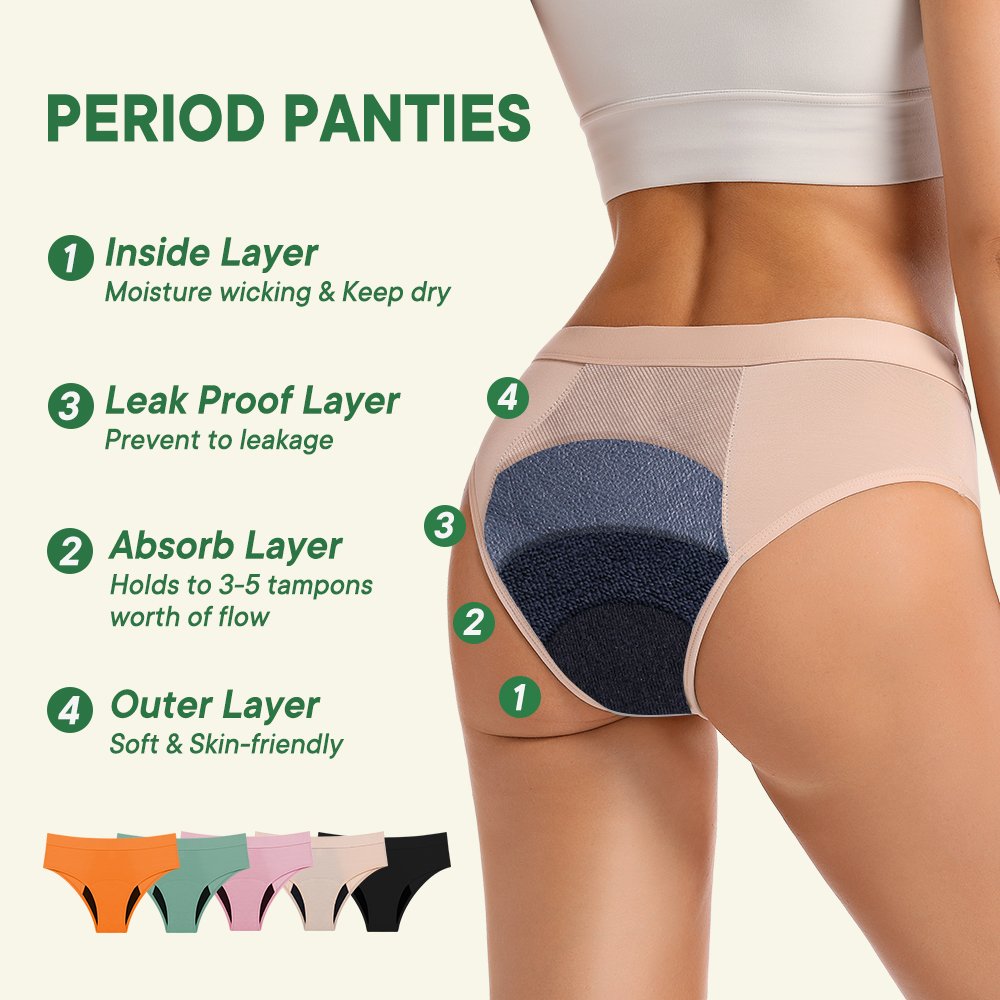
To eliminate the bulkiness associated with functional underwear, we cross-link our moisture-lock layers utilizing our signature Super Absorption Lamination Technology (SALT) . This precision engineering prevents structural shifting and delamination during high-frequency laundering.
- Engineering the Technical Incontinence Core: Hydrodynamic Surge Capture & Odor Elimination
Urinary incontinence apparel demands an infrastructure engineered for instantaneous surge absorption, chemical gelling, and aggressive gas-phase neutralization.
Layer 1: Hydrophobic Mesh Diverter Layer
Applying natural bamboo or cotton directly to an incontinence contact layer is a significant design failure. Because urine is discharged at high speed and volume, hydrophilic natural fibers saturate instantly at the contact zone, causing skin maceration and cooling discomfort.
Lynmiss Factory deploys an advanced Hydrophobic Poly-Mesh Quick-Dry Structure. This fabric acts as a mechanical one-way diverter valve. The surface fibers repel moisture, forcing the high-velocity fluid surge to pass straight through the pore distribution into the internal storage layer in under 3 seconds, leaving the skin-contact grid bone dry.
Layer 2: SAP-Infused Gelling Core Matrix
To lock low-viscosity liquid under pressure (such as when the user sits down), the core incorporates ultra-fine Super Absorbent Polymers (SAP) mechanically blended with high-loft microfibers. Upon liquid contact, the SAP particles immediately undergo a phase transition, converting free water molecules into a stable polymer gel that cannot be squeezed out.
Layer 3: Molecular Odor Engineering (Silver-Ion Melt Injection)
As urine urea breaks down into toxic ammonia (NH3), controlling volatile smells is mandatory for commercial success. Rather than using temporary topical spray finishes that wash away, Lynmiss Factory implements Permanent Melt-Injected Silver-Ion (Ag+) Filament Yarns inside the incontinence core layer.
The silver ions are locked into the polymer matrix during the fiber extrusion process. They continuously disrupt the cellular walls of odor-causing bacteria, providing durable, lifelong odor control.
- Industrial Specifications Comparison Sheet
For procurement teams and technical designers mapping out private-label lines, our engineering parameters are tightly controlled to the following tolerances:
| Performance Parameter | Lynmiss Premium Period Core | Lynmiss Technical Incontinence Core |
| Contact Layer Composition | 100% Bamboo Viscose / Combed Organic Cotton | Hydrophobic Quick-Dry Poly-Mesh Matrix |
| Storage Core Mechanism | High-Density Spunlace Cross-Linked Microfiber | Micro-SAP Polymer Blended Composite Grid |
| Gusset GSM Tolerance | Calibrated within tight $\pm 5\%$ variation limits | Calibrated within tight $\pm 5\%$ variation limits |
| Odor Suppression Tech | Botanical Bio-Antimicrobial Treatment | Permanent Extruded Silver-Ion ($Ag^+$) Filaments |
| Hydrodynamic Target | High viscosity, low velocity, slow diffusion | Low viscosity, rapid surge, high volume trapping |
- Regulatory Compliance & Global Risk Mitigation
For procurement teams representing major retailers across North America and Europe, global chemical and structural compliance is non-negotiable.
PFAS Elimination Protocol
Every batch of functional fabric manufactured at our production facility undergoes vertical compliance screening. We implement physical, mechanical lamination using high-tensile breathable TPU membranes, entirely eliminating toxic fluorochemical finishes.
We guarantee full alignment with international chemical safety regulations:
- PFAS-Free Verification: Verified via certified third-party laboratory protocols confirming Total Fluorine < 10 ppm. For an in-depth review of our automated bonding lines and alternative water-repellent chemistry, see our corporate PFAS-Free Manufacturing Guide for 2026 Compliance.
Mechanical Integrity and Metal Detection Safety
High-speed multi-layer sewing introduces the operational risk of broken needle fragments getting trapped within the garment—a liability risk that can cause catastrophic retail recalls. Our facility enforces a strict Broken Needle SOP combined with 100% conveyor belt high-sensitivity metal checking.
To review our complete factory audit workflow, automated conveyor setup, and emergency quarantine zones, read our operational brief on Zero-Metal Contamination Underwear Manufacturing
Secure Your Private Label Growth Strategy
Expanding your functional portfolio—whether launching a sensitive teen menarche collection or entering the booming adult wellness sector—requires an OEM/ODM partner with deep engineering capabilities and transparent compliance metrics.
Lynmiss Factory provides full vertical execution from initial design prototypes to high-volume bulk manufacturing. If you are preparing to run low-risk market testing or require specialized agile textile development, explore our corporate capabilities on Flexible MOQ & Agile 15-Day Prototyping
Ready to secure your supply chain and eliminate product failure risks? Submit your technical spec sheets or Tech Packs to our R&D center for an exhaustive engineering evaluation.