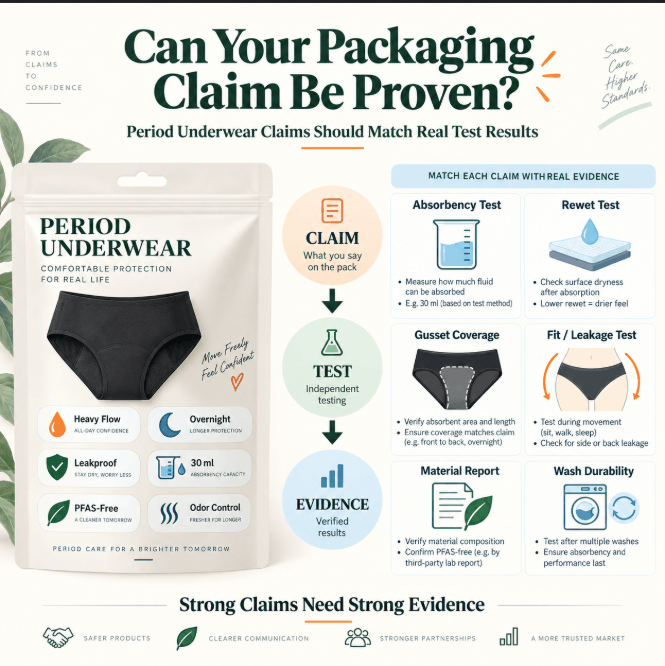
A period underwear product may perform well in testing and still create customer complaints after launch.
The problem is not always the product itself.
Sometimes, the problem is the claim.
Terms such as:
Heavy Flow
Overnight Protection
Leakproof
30 ml Absorbency
PFAS-Free
Odor Control
can help customers understand a product quickly. But if those claims are broader than the product was actually designed and tested to support, the gap between packaging and real wear becomes a brand risk.
For period underwear brands, packaging claims should be built from:
Product Design → Test Conditions → Real Use Scenario → Supported Claim
not from marketing ambition alone.
Why Packaging Claims Should Be Defined During Product Development
Claims are often treated as a final packaging decision.
That is too late.
If a brand plans to launch a product as “heavy flow,” “overnight,” or “PFAS-free,” those expectations should already be included in the development brief.
For example, “overnight” may require:
- Higher retention
- Longer rear coverage
- Lower rewet under pressure
- Side-leak control
- Stable fit during sleep
If those requirements are not defined until packaging artwork begins, the product may already be too far along to support the final claim properly.
This is why our period underwear OEM brief guide recommends defining the use scenario, absorbency target, materials, testing, and claim requirements before sampling.
1. “Heavy Flow” Needs a Defined Performance Target
“Heavy flow” sounds clear to consumers, but from a product-development perspective it is not specific enough.
Brands should first define:
- Target absorbency
- Absorption speed
- Expected wear time
- Gusset width and length
- Standalone or backup use
- Daytime or overnight positioning
A product can technically hold a high volume of liquid and still leak if absorption is too slow or the protected area is too narrow.
For this reason, “heavy flow” should not be based only on the theoretical capacity of one absorbent layer.
The final garment must support the claim.
2. A Milliliter Claim Needs Context
A number such as:
30 ml absorbency
looks objective.
But customers may interpret that number differently from the way it was tested.
Brands should understand:
- Was the liquid applied slowly or quickly?
- Was the test performed on fabric or the finished garment?
- Was pressure applied?
- Was the product washed before testing?
- Was leakage from the gusset edge considered?
- Does the number include a safety margin?
This is why capacity should be only one part of the performance story.
Our guide to leakproof testing before mass production explains why absorption speed, retention, rewet, edge leakage, coverage, and wash durability should be evaluated together.
A more useful packaging structure may combine:
Absorbency Level + Intended Use + Capacity Reference
rather than displaying a milliliter number alone.
3. “Leakproof” Does Not Mean Leakproof in Every Situation
“Leakproof” is one of the strongest claims in period underwear.
It is also one of the easiest to overstate.
A product may pass controlled leakage testing but still fail in real wear because of:
- Incorrect gusset position
- Loose leg openings
- Insufficient rear coverage
- Slow absorption
- Size-grading differences
- Movement during sports
- Sleeping position
That does not necessarily mean the leakproof barrier failed.
It may mean the claim was broader than the tested use scenario.
Brands should therefore connect “leakproof” to the intended product use rather than implying unlimited protection.
For example:
Designed for moderate daytime protection
is more specific than implying the same product is suitable for heavy flow, overnight wear, sports, and every body position.
Our article on reducing period underwear leakage complaints before production explains why absorbency, fit, coverage, and claims need to be developed together.
4. “Overnight” Requires More Than Higher Capacity
An overnight claim should not simply mean:
daytime product + thicker absorbent core
During sleep, body position changes.
Liquid may travel farther toward the rear or side of the garment, while pressure against the absorbent core can increase rewet.
An overnight product should therefore be evaluated for:
- Extended rear coverage
- Side leakage
- Rewet under pressure
- Fit stability
- Longer wear
- Wash durability
If the product has only been tested for total capacity, the brand may not yet have enough information to support an overnight positioning.
5. PFAS-Free Claims Should Match the Actual Test Scope
PFAS-free is increasingly important in period underwear marketing.
But brands should be clear about what was actually tested.
Period underwear may include:
- Body fabric
- Skin-contact lining
- Absorbent core
- Waterproof barrier
- Elastic
- Adhesive or bonding materials
A PFAS-related report may apply to one material, selected components, or the finished garment depending on the test scope.
The packaging claim should reflect that scope accurately.
If a material supplier changes after sample approval, supporting documents should also be reviewed before the same claim is used for bulk production.
This is where material traceability becomes especially valuable.
6. Odor Control Claims Need Careful Language
“Odor control” is another claim that should be connected to the actual product technology.
A product may use silver-ion yarns, antimicrobial materials, moisture-management fabrics, or fast-drying structures to help reduce odor development.
But brands should avoid turning a textile-performance claim into an unsupported medical claim.
More appropriate wording may focus on:
- Helps control odor
- Supports freshness
- Helps inhibit odor-causing bacteria
when supported by relevant testing.
The goal is to describe what the material does—not promise outcomes beyond the evidence.
Build Claims From a Claim-Evidence Matrix
Before packaging artwork is approved, brands can create a simple claim matrix.
| Packaging Claim | What Should Support It |
|---|---|
| Heavy Flow | Capacity + acquisition + coverage |
| 30 ml | Defined finished-garment test |
| Leakproof | Barrier + edge leakage + fit testing |
| Overnight | Capacity + rewet + rear/side coverage |
| PFAS-Free | Relevant material/product test scope |
| Odor Control | Material technology + supporting test |
| Reusable | Wash-performance evaluation |
This creates a much clearer connection between the marketing team and the development team.
What Should Brands Confirm Before Printing Packaging?
Before approving final packaging, confirm:
- What exactly was tested?
- Was the test performed on the finished garment?
- What use scenario was tested?
- Does the claim match the tested condition?
- Does the packaging imply broader protection than the product can provide?
- Are material claims supported by the correct documents?
- Has the bulk-production material changed since sample approval?
- Are the same claims used consistently across packaging, website, and advertising?
This review is much easier before thousands of boxes or bags have already been printed.
How Lynmiss Factory Supports Claim Development
At Lynmiss Factory, product development can connect absorbency, fit, gusset coverage, materials, testing, and private-label packaging before mass production.
For OEM and ODM programs, brands can define the intended claims during the sampling stage and then evaluate whether the approved sample supports those claims through testing and documentation.
The goal is not to make the strongest possible claim.
It is to make the strongest claim the product can reliably support.
Final Takeaway
A good period underwear claim should begin with product evidence.
Not with the packaging headline.
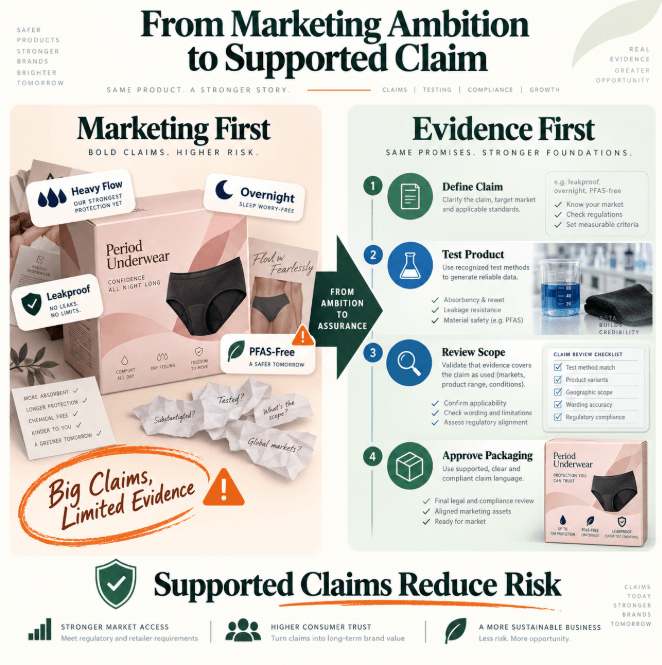
For brands, the safest development sequence is:
Define the Claim → Design for the Use Scenario → Test the Finished Garment → Review the Evidence → Approve the Packaging
Because the cost of changing a claim before printing is small.
The cost of correcting an overstated claim after launch can include complaints, poor reviews, returns, and lost trust.
A period underwear claim should be written from test results—not marketing ambition.
Explore Lynmiss Factory OEM/ODM period underwear development at www.misiundies.com.