
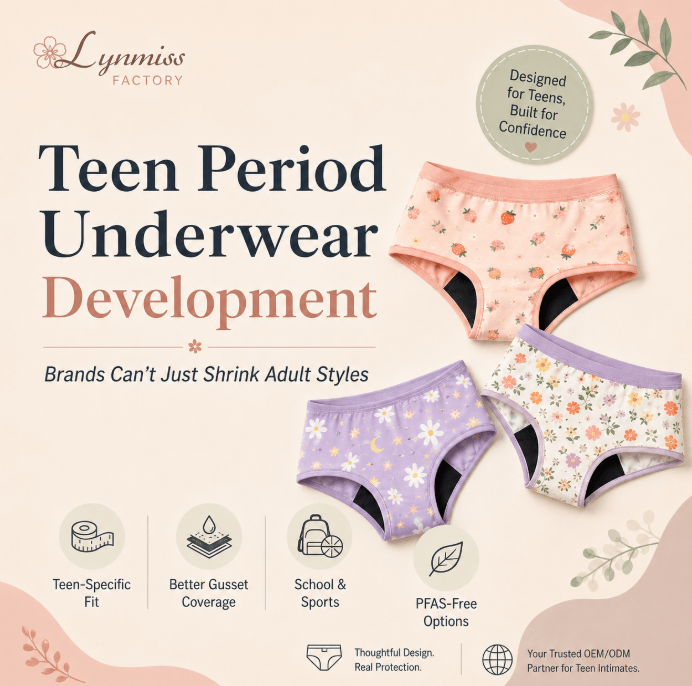
A smaller adult brief may look acceptable on a sample table. But once a teen wears it through a school day, the weaknesses can become clear: the gusset may sit in the wrong position, the leg openings may gap, the absorbent area may feel bulky, and the product may shift during sports or sleep.
Teen period underwear needs its own development strategy. Brands must rethink fit, coverage, absorbency, materials, testing, and communication instead of reducing an adult pattern by one or two sizes.
Mistake 1: Using a Reduced Adult Size Chart
Teen bodies do not scale down in the same proportions as adult bodies. Waist-to-hip ratios, rise depth, leg shape, and torso length can differ, while growth patterns vary among users of the same age.
A teen range should therefore be built from body measurements and fit trials rather than age labels alone. Brands should define waistband stretch, front and back rise, leg-opening tension, gusset position, and movement comfort for each size.
The waistband must feel secure without excessive compression. Leg openings need enough recovery to stay close to the body without digging into the skin. Poor grading can cause discomfort and side leakage during long school days.
Mistake 2: Shrinking the Protection Zone With the Garment
A smaller garment does not automatically require a proportionally smaller gusset.
First-period users may be unfamiliar with their flow pattern or the best time to change. They may also have limited access to bathrooms between classes. If the absorbent area is too short, narrow, or incorrectly positioned, liquid can reach an unprotected edge even when the core still has unused capacity.
Brands should review gusset width, front and rear extension, position during movement, side-leak control, and alignment across the full size range.
Our guide to reducing period underwear leakage complaints before production explains why capacity, fit, coverage, and leg openings must be developed as one system.
Mistake 3: Giving Every Teen Style Maximum Absorbency
More absorbency is not always better.
Adding a thick core to every style can make the underwear feel hot, stiff, slow to dry, or visible under uniforms and leggings. For first-period users, a bulky product may also feel unfamiliar and discourage regular use.
A clearer teen collection could include light or backup protection, moderate school-day protection, heavy protection, and an overnight style with extended rear coverage.
Each product should have a distinct use case. A thin school-day brief and a secure overnight boyshort solve different problems and should not use the same structure.
Mistake 4: Ignoring School and Sports Movement
A sample that fits while standing may fail during real activity.
Teen products should be reviewed during sitting, walking, running, cycling, stretching, and repeated changes of posture. Waistbands can roll, gussets can shift, and loose leg openings can create leakage paths.
For school use, brands should prioritize discreet edges, breathable materials, secure fit, and protection that remains stable for several hours. For sports, stretch recovery and friction control are especially important.
A product that protects well but creates obvious bulk may still be rejected by the target user.
Mistake 5: Treating Overnight and Swimwear as Ordinary Briefs
Overnight products require more than a higher milliliter claim. They need longer front-to-back coverage, stable side protection, and reliable performance under pressure as the wearer changes sleeping position.
Period swimwear is a separate engineering category. It must manage menstrual flow while limiting excessive pool or seawater intake. A standard period-underwear gusset cannot simply be inserted into a swimsuit without product-specific material and water testing.
Brands planning school-day, overnight, and swim products should define separate performance targets instead of using one universal core.
Mistake 6: Using Safety Claims Without a Material Strategy
Parents often pay close attention to materials used next to the skin, especially for first-period products.
Terms such as “non-toxic,” “organic,” and “PFAS-free” should not be treated as decorative marketing language. Brands need to understand which materials are used in the lining, absorbent core, waterproof barrier, elastics, prints, dyes, and bonding components.
Cotton and organic cotton offer a familiar handfeel, while bamboo-derived and performance fabrics may provide different moisture-management and drying characteristics.
Brands considering a natural-fabric collection can review the organic cotton period underwear OEM guide before deciding how the body fabric, lining, absorbency, and waterproof layer should work together.
Mistake 7: Using Adult Lingerie Language and Packaging
Teen packaging should not feel childish, but it should also avoid adult lingerie language that may feel inappropriate for younger users or uncomfortable for parents.
Product pages and packaging should clearly explain the recommended flow level, whether the product is standalone or backup protection, suitable use scenarios, washing instructions, changing guidance, and sizing.
A reassuring and practical tone can make the product easier for teens to understand and easier for parents and retailers to trust.
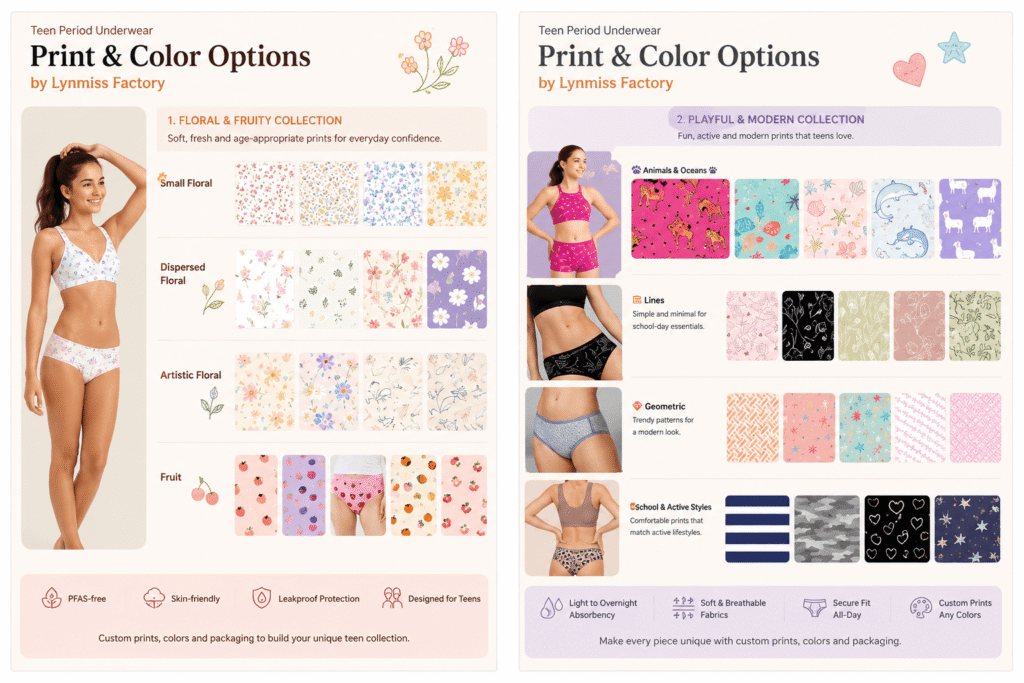
Visual design also influences whether teens are willing to wear the product. Prints should feel age-appropriate without appearing childish. Small florals, soft geometric patterns, fruit motifs, ocean themes, and simple line graphics can help brands build distinct first-period, school-day, active, and lifestyle collections.
Test the Complete Garment Before Mass Production
A teen product should not be approved from a fabric swatch, appearance sample, or theoretical capacity figure.
The finished garment should be tested for absorption speed, total retention, rewet under pressure, side and rear leakage, wash durability, stretch recovery, and size-to-size consistency. Movement and wear trials should reflect the intended use scenario.
The process described in how leakproof testing works before mass production helps brands identify failures while the gusset, fit, material, and construction can still be adjusted.
When a fabric, membrane, absorbent core, pattern, or seam method changes after approval, the relevant tests should be repeated.
How Lynmiss Factory Supports Teen-Specific Development
At Lynmiss Factory, teen product development can begin with the intended use case rather than a reduced adult pattern.
Brands can compare separate size grading, gusset positions, absorbency levels, fabrics, and construction methods for school-day, active, overnight, and swimwear collections. Development options include light-to-heavy absorbency, PFAS-free leakproof barriers, side-leak structures, soft skin-contact fabrics, sewn or bonded finishes, custom colors, labels, and age-appropriate packaging.
Before bulk production, the complete garment can be reviewed for fit, absorption speed, rewet, gusset coverage, wash durability, stretch recovery, and movement-related leakage.
Final Takeaway
The strongest teen period underwear collections are not smaller versions of adult products.
They are developed around teen body proportions, first-period uncertainty, school routines, sports movement, overnight needs, material trust, and clear communication.
By building a separate fit system, matching the gusset to the real use case, avoiding unnecessary bulk, and testing the complete garment before production, brands can reduce leakage complaints and create products that teens are more willing to wear—and parents are more willing to trust.