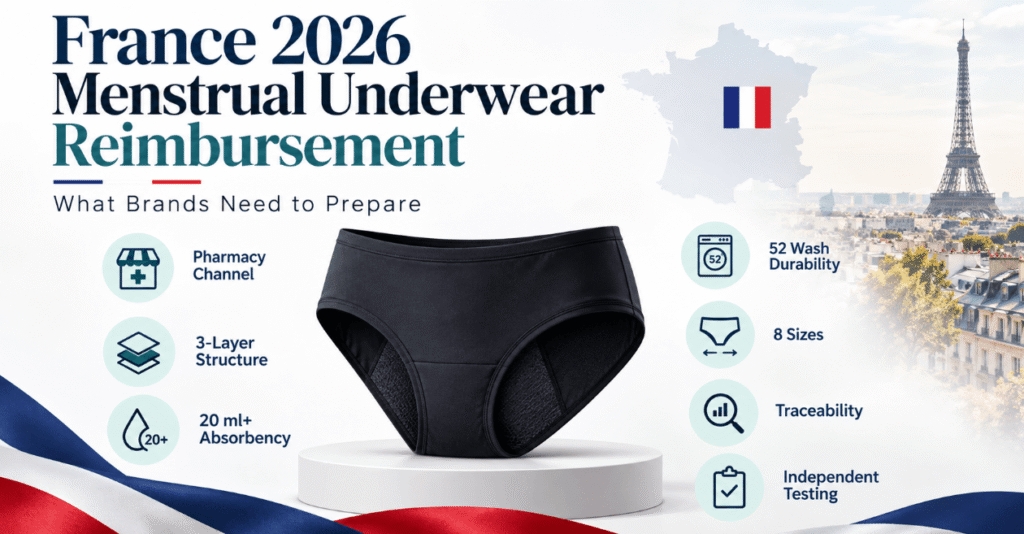
From October 1, 2026, France will begin reimbursing eligible reusable menstrual products, including menstrual underwear and menstrual cups, through its health insurance system.
For insured people under 26, Assurance Maladie will reimburse 60% of the eligible cost, while beneficiaries of the Complémentaire santé solidaire (C2S) can receive 100% reimbursement regardless of age. The scheme is limited to two reusable menstrual products per year and products must be dispensed through pharmacies.
For menstrual underwear brands, however, the biggest change is not simply reimbursement.
It is that France has created a detailed technical framework defining which menstrual underwear can enter the reimbursable system.
For OEM and private-label brands, this turns the French pharmacy channel into a product-development and compliance project—not just a sales opportunity.
France Has Created a New Pharmacy Channel for Menstrual Underwear
The French reimbursement list includes menstrual underwear under LPP code 1724852.
The current official schedule sets:
- Maximum retail price: €19 including VAT
- Transfer price: €14.40 excluding VAT
- Distribution: French pharmacies
- Eligible quantity: two reusable menstrual products per person per year
To qualify for reimbursement, the product must meet the technical and documentation requirements defined in the French order of August 6, 2026.
This means brands targeting the reimbursement market need to think about product engineering, testing, pricing, sizing, packaging, documentation, and distribution together.
1. Testing Must Be Performed by an Independent European Laboratory
The French rules require all relevant tests for menstrual underwear to be performed by an independent European laboratory accredited to ISO/IEC 17025.
For brands, this is important because internal factory tests alone will not be enough for reimbursement qualification.
Testing strategy should therefore be defined before the final sample is approved.
A brand should know:
- Which tests are required
- Which samples will be submitted
- Which wash protocol will be used
- Which claims will appear on the packaging
- Which laboratory reports must support the application
This is consistent with the broader principle explained in our guide to leakproof testing before mass production: the complete garment should be evaluated against the intended use scenario before bulk production begins.
2. The Product Must Use at Least Three Functional Layers
Reimbursable menstrual underwear must contain at least:
Layer 1 — Skin-contact / drainage layer
Layer 2 — Absorbent layer
Layer 3 — Waterproof anti-leak layer
The skin-contact layer must be made from organic cotton or lyocell.
If organic cotton is used, the regulation requires at least 95% organic cotton certified GOTS Organic or equivalent, with up to approximately 5% elastane permitted where necessary for elasticity.
This is especially relevant for brands developing cotton-based programs. Material requirements should be confirmed before sampling, as discussed in our organic cotton period underwear OEM guide.
3. OEKO-TEX Becomes a Core Product Requirement
The rules require the entire menstrual underwear product to hold OEKO-TEX Standard 100 Class I or Class II certification.
The certificate must be less than one year old and must be submitted again annually after the product is listed.
For brands, the key point is that certification cannot simply apply to one fabric swatch.
The material system, supplier documentation, and final product configuration need to remain consistent with the approved product.
4. Absorbency Must Meet Defined Minimums
France has also established clear absorbency requirements.
To enter the reimbursable system, an operator must offer at least one menstrual underwear product with a capacity of 20 ml or more.
Additional products may have different absorbency levels, but they must exceed 12 ml.
The absorbency capacity must also appear on the product packaging.
For brands, this is a major change.
Marketing terms such as “moderate,” “heavy,” or “overnight” now need to be supported by a measurable performance target rather than used only as general category language.
5. Absorbency Must Remain Stable After 52 Wash Cycles
The French framework does not only test a new garment.
Absorbency must be measured after one wash cycle and at least 52 maintenance cycles, using the product’s care instructions and a minimum wash temperature of 30°C.
Testing should follow a documented protocol inspired by ISO 20158 or an equivalent method.
Most importantly, the difference in absorption capacity after 52 cycles must remain within 10%.
This has an important implication for product development:
Reusable performance now needs to be demonstrated, not assumed.
For manufacturers, building internal wash-performance standards above the minimum can also provide a useful development margin before third-party testing.
6. Durability Is More Than Absorbency
After 52 wash cycles, the garment must also maintain acceptable physical performance.
The regulation specifies requirements including:
- Knitted dimensional change within ±10%
- Woven dimensional change within ±6%
- Pilling grade of at least 3–4
- Color degradation grade of at least 3
- No breakage at seams or bonded areas
- No significant elastic degradation
- No fabric tearing
For brands, this means bonded construction, seam durability, elastic recovery, and fabric selection become part of reimbursement readiness.
A sample cannot simply pass an initial absorbency test and be considered finished.
7. Real-Use Wear Testing Is Required
One of the most unusual requirements is a real-use tolerance test.
At least 30 menstruating participants must wear the product under gynecological and dermatological supervision.
The test requires:
- 10–12 hours of wear per day
- At least 21 days of testing
- At least one menstrual episode
- Evaluation for irritation, allergic reaction, and skin tolerance
For brands, this means final fit, seams, skin-contact materials, and long-wear comfort should be resolved before entering formal testing.
Repeated sample changes after the user trial could create additional validation work.
8. Size Range and Traceability Are Also Part of Qualification
Every reimbursable menstrual underwear style must be available in at least eight sizes.
The range must include at least one 12–14-year-old teen size or equivalent, and brands must provide a relationship between their size system and body measurements such as hip circumference and height.
That teen-size requirement is strategically important because the reimbursement scheme specifically targets younger users.
France is therefore not only opening a pharmacy channel for adult period underwear—it is also creating an opportunity for properly engineered teen and first-period products.
Manufacturing traceability is another explicit requirement. Companies must describe traceability at each stage of production and demonstrate appropriate social and environmental manufacturing standards through accepted certifications or equivalent systems.
Brands preparing for this market should therefore be able to connect:
Material Lot → Production Lot → Finished Product → Test Report → Certification
Our guide to fabric traceability in period underwear production explains why this type of lot-level connection is increasingly important for both compliance and quality control.
France Reimbursement Readiness Checklist
| Area | Key Requirement |
|---|---|
| Laboratory | Independent European ISO/IEC 17025 lab |
| Structure | Minimum 3 functional layers |
| Skin-contact material | Organic cotton or lyocell |
| Product certification | OEKO-TEX Standard 100 Class I or II |
| Absorbency | At least one style ≥20 ml; others >12 ml |
| Wash performance | Test after 1 and ≥52 cycles |
| Absorbency variation | Within 10% after wash testing |
| Wear test | ≥30 users, 21 days, 10–12 h/day |
| Size range | Minimum 8 sizes |
| Teen size | At least one 12–14-year equivalent |
| Traceability | Every production stage documented |
| Distribution | French pharmacy channel |
What This Means for Brands
The French reimbursement program changes how period underwear for this channel should be developed.
Brands should not wait until the product is already finished before asking:
“Can this qualify for reimbursement?”
A better process is:
Target France LPP → Define Product Specification → Select Compliant Materials → Build Sample → Validate Fit → Complete Laboratory Testing → Prepare Traceability & Documentation → Apply for Listing
This reduces the risk of developing a product first and discovering later that the fabric, size range, wash performance, testing method, or documentation does not meet the French requirements.
How Lynmiss Factory Can Support Development
For brands preparing products for France, Lynmiss Factory can support OEM/ODM development around material selection, absorbency structure, gusset design, teen and adult sizing, sewing or bonded construction, wash-performance preparation, traceability, private-label packaging, and supporting documentation.
The French reimbursement framework is a good example of where product development and compliance can no longer be treated separately.
The product has to be engineered for the target channel from the beginning.
Final Takeaway
From October 1, 2026, France will create a new reimbursable pharmacy channel for reusable menstrual underwear.
But access to that channel requires much more than a good-looking period brief.
Brands need to prepare for:
Certified materials → measurable absorbency → 52-wash durability → real-use testing → broad sizing → teen sizing → traceability → pharmacy distribution
For OEM brands, the opportunity is significant—but the product brief needs to start with the French requirements, not be adapted to them after production.
Explore Lynmiss Factory OEM/ODM period underwear development at www.misiundies.com.
This article is for general B2B sourcing information and is not legal or regulatory advice. Brands should confirm current listing and reimbursement requirements with the relevant French authorities before market entry.